
When conducting face-to-face fieldwork, market researchers have a choice of sampling methods to work with. Given that each has its own pros and cons for data quality, workload efficiency and project control, it’s important to understand the differences.
Here is a practical overview of the most common CAPI sampling setups, all of which are available in Nfield. Armed with this information, you can decide what’s most appropriate for each survey situation you encounter.
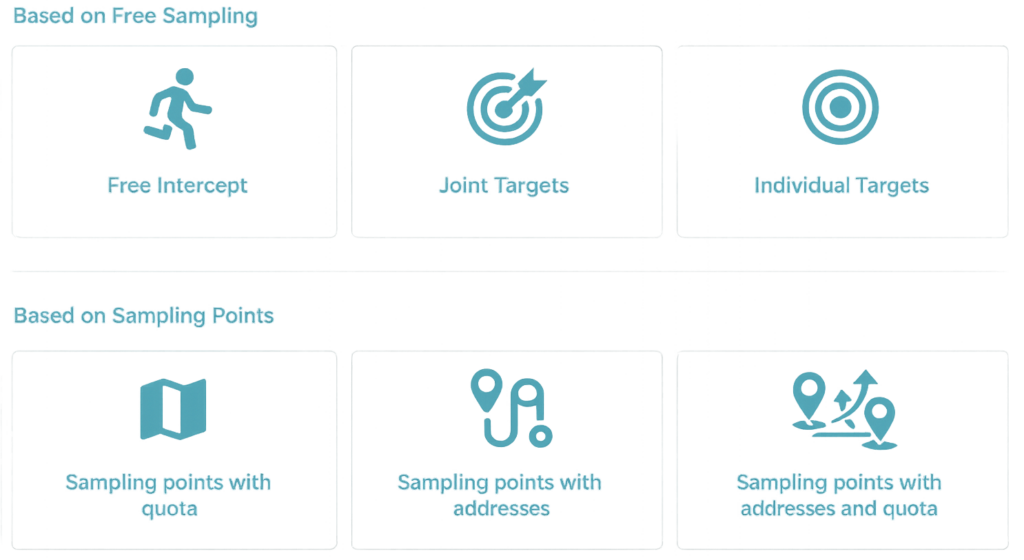
Free Intercept: for maximum flexibility
Free Intercept is the simplest and most flexible sampling method.
Free Intercept allows interviewers to approach respondents and conduct interviews without any predefined targets, quotas or structure. This makes it ideal for:
- Exploratory research
- Pilot studies
- Situations where speed is more important than strict control
The trade-off
Because Free Intercept has no controls, it’s harder to ensure representativeness.
To mitigate this, fieldwork usually needs closer monitoring (and clear interviewer guidance) to avoid bias.
Joint Targets: for ensuring representativeness
Joint Targets (often implemented as quotas) introduce structure by defining shared targets for specific respondent groups, such as:
- Gender
- Age
- Region
Interviewers – as a group – are required to meet predefined quotas. This helps ensure the achieved sample matches the intended distribution on those variables.
This method is widely used when:
- Representativeness is critical
- Balanced data is needed across key variables
- Wanting to avoid over- or under-sampling of certain groups
The trade-off
Joint Target quotas improve balance on the specified variables, but they don’t guarantee representativeness beyond those variables.
To mitigate this downside, you should plan clear quota definitions, monitor progress frequently, and avoid making quotas so tight that fieldwork stalls.
Individual Targets: for structured flexibility
Individual Targets add structure by assigning each interviewer or team with their own individual completion target. Instead of working toward one shared quota, each has their own goal (for example: 20 interviews per interviewer or 50 per city team). It’s a good way to spread the workload evenly while keeping fieldwork flexible.
This setup is especially useful when you want to retain operational control over progress and coverage, such as in:
- Multi-location studies
- Fieldwork that needs coordination, but not strict demographic control
The trade-off
The main trade-off is that Individual Targets don’t automatically balance the sample on demographics like age or gender.
If representativeness matters, individual targets should be combined with screening rules, soft quotas, or frequent field monitoring to avoid drift (for example, one interviewer over-recruiting an “easy-to-reach” group).
Overall, Individual Targets are a good middle ground when you need structure for delivery, but don’t need strict demographic balancing built into the design.
Sampling Points with Quotas: where control meets scalability
Sampling Points with Quotas lets you divide fieldwork into logical segments—such as cities, stores, regions, or time slots—and apply quotas within each segment.
Each sampling point has its own target and (if needed) its own quota grid. Interviewers are assigned to specific points and can only complete interviews that fit the open quotas for that point.
It scales well because you can control both geographic coverage and sample composition at the same time.
Under Sampling Points with Quotas, you typically define:
- Sampling points (e.g., cities, stores, locations)
- Quotas (e.g., age, gender)
This is particularly effective for:
- Large-scale studies
- Multi-region projects
- Research requiring both geographic and demographic balance
The trade-off
This setup needs careful quota design per sampling point. Otherwise, some points may finish early while others get stuck. It’s important to keep an eye on point-level progress and be ready to reallocate interviewer capacity.
Sampling Points with Addresses: for real-world targeting
With address-based sampling, each sample consists of predefined addresses rather than open respondent selection. Interviewers receive a list of addresses and attempt to conduct interviews at those locations.
This method enables:
- Preloading respondent or location data
- Tracking contact attempts and non-response reasons
- Managing appointments with respondents
If no quotas are applied on top of the address list, interviewers work through the assigned addresses freely, making this approach suitable for:
- Customer follow-ups
- B2B or household-based research
- Studies with pre-identified respondents
The trade-off
Address-based work is sensitive to non-response.
To mitigate this weak point, you need to have clear contact rules (number/timing of attempts), outcome codes, and a plan for replacements (if allowed) so the achieved sample doesn’t drift.
Sampling Points with Addresses and Quotas: for maximum control
Sampling Points with Addresses and Quotas are the most structured setup, giving control of where interviewers go (sampling points), who they should contact (addresses), and what the achieved sample should look like (quotas).
Sampling Points with Addresses and Quotas combines:
- Sampling points (fieldwork structure)
- Addresses (predefined sample units)
- Quotas (data control)
This approach allows you to:
- Precisely target respondents
- Monitor every contact attempt
- Ensure balanced and representative outcomes
It is ideal for:
- High-quality tracking studies
- Government or official statistics
- Complex, multi-layered research projects
The trade-off
This level of control increases setup effort and operational complexity. It is important to factor in the time needed for sample preparation, interviewer training and live monitoring, so you can resolve quota bottlenecks and address issues quickly.
In practice, teams often combine these methods—e.g. using sampling points to manage geography and quotas to keep key demographics balanced—depending on budget, timeline and the level of control required.
Final thoughts
CAPI sampling methods have evolved far beyond simple interviewer assignments. Today, they offer a flexible toolkit that allows researchers to design fieldwork that is both efficient and methodologically sound.
By choosing the right sampling method—or combination of methods—you can significantly improve fieldwork performance, data quality and overall project success.
For a deeper dive into these approaches, see the NIPO Academy webinars: Academy 64: The Current State of Nfield CAPI I – The Basics, Academy 65: The Current State of Nfield CAPI II – Sampling Points, and Academy 66: The Current State of Nfield CAPI III – Sampling Points with Addresses.